Our team is here to help you design, price, and deploy the right system.

Our team is here to help you design, price, and deploy the right system.
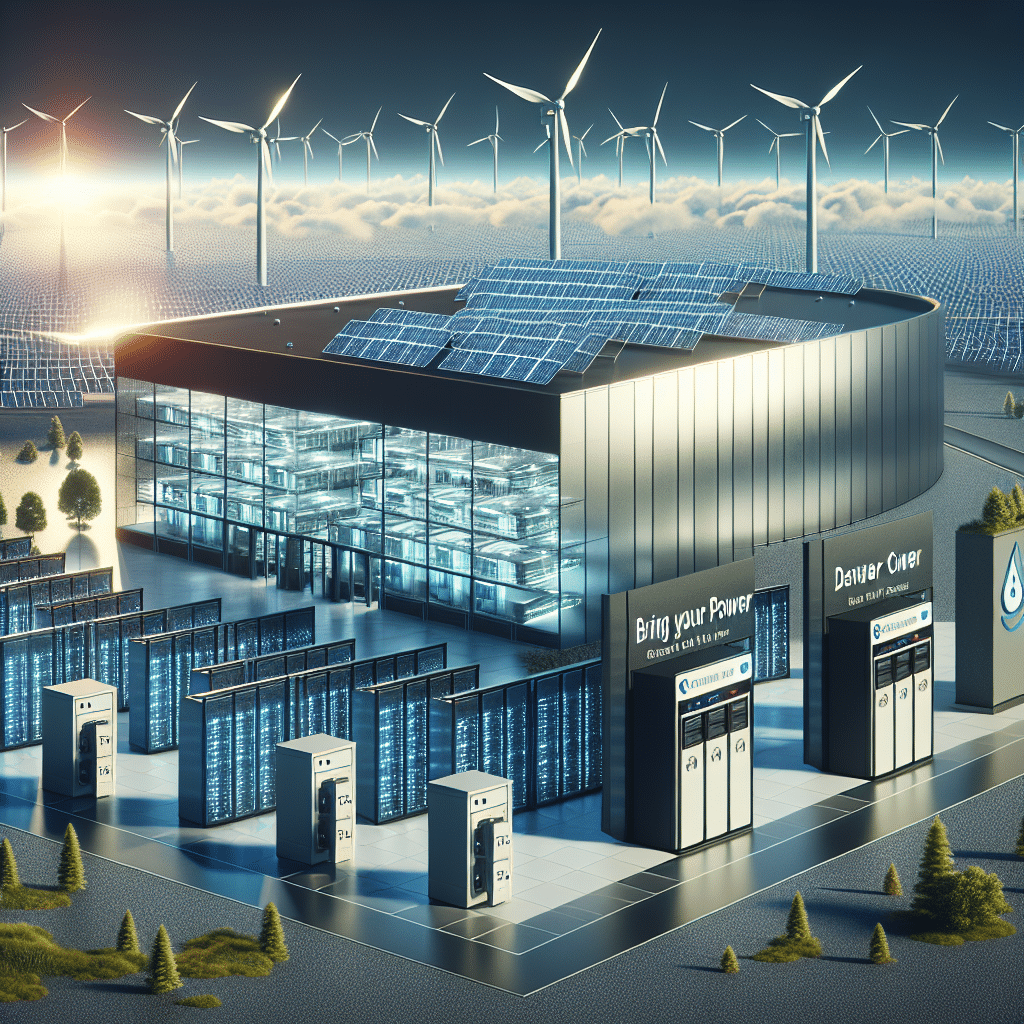
When Alphabet announced its $4.75 billion acquisition of clean energy developer Intersect Power in late December, it wasn’t just another tech deal. It was a declaration that the old model of data center development—where operators simply plug into the local grid and hope for the best—is officially over.
For the first time, a major hyperscaler has directly acquired an energy developer rather than signing power purchase agreements (PPAs) or waiting in utility interconnection queues. The message from Google is clear: if you want to build AI infrastructure at scale in 2026, you need to own the entire power stack—from generation to the data hall.
Intersect CEO Sheldon Kimber put it bluntly in his blog post announcing the deal: “AI today is stuck behind one of the slowest, oldest industries in the country: electric power. The country has racks full of GPUs that can’t be energized because there isn’t enough electricity for them.”
The numbers tell the story. PJM Interconnection, the nation’s largest grid operator serving 65 million people across 13 states, projects it will be six gigawatts short of reliability requirements by 2027. Utility interconnection delays now stretch two to three years or longer. Meanwhile, data centers can be built in nine to twelve months—leaving operators with finished buildings and no power to run them.
The mismatch is creating what industry experts call a “power-first” planning paradigm. As Lenovo’s Simone Larsson noted in recent 2026 predictions, “Energy will overtake compute as the primary design constraint for AI infrastructure.” Data center planning now begins with energy availability, efficiency, and location—not server density.
The Intersect acquisition gives Alphabet control over “multiple gigawatts” of energy and data center projects, including a flagship co-located facility in Haskell County, Texas. This 840 MW solar installation with 1.3 GWh of battery storage is being built alongside a new data center campus—the first of what Intersect calls “energy parks.”
The energy park model fundamentally changes how data centers connect to power. Instead of drawing from the regional grid, these facilities co-locate generation, storage, and compute under a single development plan. The approach offers several advantages:
| Advantage | Impact |
|---|---|
| Speed to Power | Bypass 2-3 year interconnection queues; Haskell County operational by 2026 |
| Grid Independence | Operate as a private microgrid; avoid grid congestion and capacity constraints |
| Cost Control | Avoid utility rate increases; insulate from volatile wholesale power markets |
| Community Relations | Don’t strain local grids or pass costs to residential ratepayers |
Once operational, Google’s Haskell facility will function like a private microgrid—ERCOT sees it as a single demand-plus-generation node. The data center can run at full capacity without drawing additional power from the wider Texas grid, using batteries and backup gas generation to fill gaps and ensure 24/7 operation.
The Intersect deal also reflects mounting political pressure on data center operators. Senator Bernie Sanders has called for a national moratorium on data center construction, while Florida Governor Ron DeSantis has emerged as a leading skeptic of the AI industry’s impact on electricity prices. With residential electricity prices forecast to rise another 4% in 2026 following a 5% increase in 2025, data centers are becoming political lightning rods.
The PJM watchdog has proposed that the grid reject data centers it cannot serve—or require them to bring their own generation. Maryland is considering legislation that would require data centers to use clean backup power during peak periods. State governors, including Maryland’s Wes Moore, have called for PJM to provide incentives for data centers to bring their own power.
This regulatory trajectory makes the “bring your own power” model not just attractive but potentially mandatory. As Kimber noted, the business model for electricity has “trended towards a bring your own generation framework.” Google’s acquisition positions it ahead of this curve.
Google isn’t alone in pursuing grid-independent infrastructure. Houston-based GridFree AI recently announced its first “Power Foundry” site in South Dallas, part of a planned three-site campus with nearly 5 GW of combined gross power capacity. Goldman Sachs is co-leading the financing.
GridFree’s model uses U.S.-produced natural gas to power data centers independently of local electrical grids. The company claims it can deliver initial power within 24 months from lease signing—significantly faster than traditional grid-connected developments. CEO Ralph Alexander, formerly of Talen Energy, called South Dallas One “the future of AI-ready infrastructure: fast to deploy, resilient by design, and insulated from the grid constraints holding back the industry.”
The Texas market is particularly suited to this approach. ERCOT’s deregulated structure allows for more flexible power arrangements, and the state’s role in the $500 billion Stargate project—with campuses across Abilene, Shackelford County, and Milam County—demonstrates continued appetite for large-scale data center development.
The shift to self-generation doesn’t eliminate the need for electrical infrastructure—it transforms it. Energy parks and grid-independent facilities require sophisticated on-site power systems that integrate generation, storage, and distribution under a single operational framework.
The Intersect acquisition and GridFree’s emergence signal a broader industry shift. As Compass Datacenters’ Clift Pompee noted, “2026 is a pivotal year for the future of the U.S. power grid. Most of the grid was built between the 1950s and 1970s, and today, approximately 70% of the grid is approaching the end of its life cycle.”
Rather than waiting for grid modernization that may take decades, operators are increasingly choosing to build their own power infrastructure. EdgeCore’s Tom Traugott predicts that “data centers will play a more active role in stabilizing the grid and mitigating cost increases by securing strategic investment and promoting load flexibility.”
For data center developers and operators, the message is clear: power is no longer a background infrastructure concern. It’s the central strategic constraint that will determine where facilities are built, how quickly they can be deployed, and whether they can meet the demands of AI workloads at scale.
The “bring your own power” era has arrived. The operators who thrive will be those who can integrate generation, storage, distribution, and cooling into cohesive energy parks—built to U.S. standards, delivered on aggressive timelines, and designed to scale with the insatiable demands of artificial intelligence.
BixBit USA delivers custom-built power and cooling systems engineered for AI data centers, Bitcoin mining operations, and high-performance computing facilities. From custom transformers and switchgear to integrated cooling solutions, our infrastructure is built to U.S. standards (UL, ANSI, IEEE) with faster turnaround times than industry competitors.
Whether you’re building a grid-independent energy park or upgrading existing facilities, BixBit USA provides the power infrastructure to bring your projects online faster.
Contact BiXBiT USA today to discuss your power and cooling requirements.